


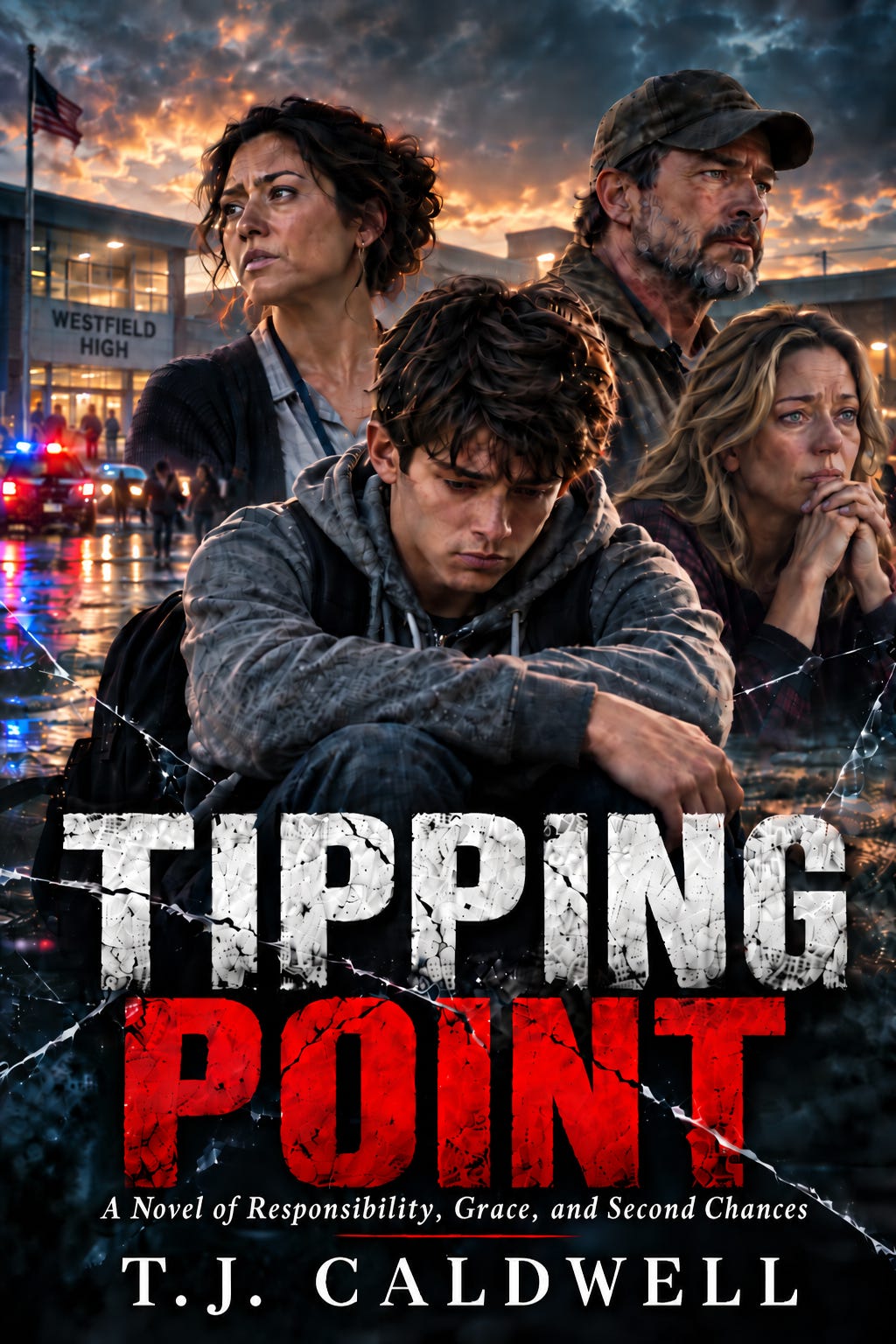
Welcome, Readers!
I’m so excited to finally share a little of my debut novel, Tipping Point, with you!
The book is scheduled for release in paperback and Kindle editions in late November 2026. But I don’t want you to have to wait until then to get a glimpse of the story.
Today, I’m sharing the Preface, Prologue, and Chapter 1, absolutely free!
Tipping Point is a story about the pressures we sometimes fail to recognize in others, the consequences of a single decision, and the power of faith, forgiveness, and second chances.
I hope these opening pages draw you into the story and leave you wanting to know what happens next. I’d genuinely love to hear your thoughts, so please feel free to leave a comment and let me know what you think.
And if you enjoy what you’re reading, I’d love for you to subscribe to my Substack. It’s completely free! You’ll receive updates as Tipping Point approaches publication, along with occasional excerpts, behind-the-scenes glimpses into my writing journey, and news about my second novel, Vanished on Mission, planned for release in late spring or early summer 2027.
Thank you for being part of this new chapter in my life. After years of dreaming about writing a book, it’s especially meaningful to finally share these pages with you.
Happy reading!
T.J. Caldwell
______________________________________________________________
Preface
Why I Wrote This Book
Some things happen in a community that never quite leave, even after the news trucks are gone and the headlines have moved on.
For a while, everyone talks about what happened. We hear the experts, read the stories, discuss it with friends and neighbors, and eventually ask the question that seems to follow every tragedy:
How could this happen?
Not long ago, something happened close to my own neighborhood that left people asking that question. There was plenty of blame to go around—the person responsible, the parents, the school, the system, the warning signs that seemed so obvious once everyone knew how the story ended.
I understood the desire to find an answer. If we can identify the moment when everything went wrong, perhaps we can recognize it next time and stop it before someone gets hurt.
But another question stayed with me. What happens inside a person before the moment everyone else finally sees?
That question became the beginning of Tipping Point.
This is not a story meant to excuse violence or lessen personal responsibility. People are accountable for the choices they make, especially when those choices harm others. Understanding someone’s pain does not erase the pain they caused.
At the same time, people rarely arrive at their worst moment in a single step. Sometimes the warning signs look surprisingly ordinary: exhaustion, isolation, perfectionism, fear of disappointing someone, or a child who has become very good at saying, I’m fine.
That interested me because responsibility is rarely as simple as we would like it to be. Parents can love their children deeply and still miss what is happening inside them. Expectations intended as encouragement can be heard as something very different. A frightened or desperate person can be suffering terribly and still be responsible for the choices made in that suffering.
More than one thing can be true at the same time.
That idea became one of the foundations of this novel. Compassion does not require us to deny harm, and accountability does not require us to stop seeing the human being who caused it.
My faith shaped the story as well. I believe human life has value before a person accomplishes anything, succeeds at anything, or earns anyone’s approval. That belief is easy when someone is doing well. It becomes much harder when someone has failed badly and other people have been hurt because of it.
But if our worth truly comes from God, then it cannot disappear on the worst day of our lives. That truth must apply to everyone—the person who made the terrible choice and the people forced to live with its consequences.
I also came to see redemption differently while writing this book. Redemption is not an escape from responsibility. Sometimes it begins by looking honestly at what happened, listening to the people who were hurt, and accepting that I’m sorry cannot undo what was done.
Then comes the harder part. You keep living, and you decide what you will do with the life that remains.
Tipping Point is fiction. Marcus Sheridan, Alena Alvarez, Victoria and Randy Carter, Mitchell and Lila Sheridan, and the other characters in these pages are not intended to represent particular people from any real event. The questions behind their story, however, are very real.
How well do we see the people closest to us? How easily can achievement become confused with worth? Can we hold someone responsible for the worst thing they have done without deciding it is the only thing they will ever be?
Those are the questions at the heart of this story.
Sometimes the warning is dramatic.
Sometimes it is simply the word fine.
And sometimes one of the most important things we can do for another human being is notice that it may not be true—and stay long enough to listen.
T.J. Caldwell
______________________________________________________________
Prologue
The Night Before
Marcus Sheridan stared at the number on his phone until the screen dimmed.
He tapped it awake again.
The grade was still there.
Of course it was.
Apparently technology had not yet developed enough compassion to change a test score simply because someone had stared at it long enough.
He swallowed and leaned back against the edge of his desk chair.
A message from someone in his physics class sat beneath the notification.
rough test huh
Marcus read it, locked the phone, set it beside him, then picked it up again less than ten seconds later.
Still there.
He knew the number wasn’t catastrophic. At least, that was what someone else might say.
One test.
One grade.
Not the end of the world.
But other people didn’t hear those conversations the way Marcus did.
Other people didn’t know how many conversations lately had somehow managed to turn into college, scholarships, class rank, applications, or the mysterious importance of “keeping your options open,” which seemed to require making sure every option was perfect before you were even old enough to vote.
He rubbed both hands over his face.
His dad would ask about it. Maybe at dinner. Maybe tomorrow. Either way, the question was coming.
He wouldn’t be cruel. That almost made it worse. His father believed in effort, discipline, consistency, and the idea that a person could solve nearly anything by working harder and complaining less. Marcus had heard some variation of that philosophy for most of his life.
Usually it made sense. Tonight it felt like a wall.
He looked at the grade again. This was how it started. Not with disaster. With slipping.
One bad grade became another. One missed assignment turned into a lower average. The class rank dropped. College options narrowed. His parents stopped saying you’re doing great and started asking what had happened.
He could already hear the questions. Had he studied enough? Was he distracted? Did he need tutoring? Was something going on?
That last one almost made him laugh. Something had been going on for months. Nobody seemed to notice unless it showed up in the gradebook.
Marcus set the phone down and stared at the floor between his shoes. There had been a time when school was simply something he did. Now it felt like evidence. Proof that he was either becoming the person everyone thought he should be or disappointing them one percentage point at a time.
He had tried harder. That was the part nobody understood.
He had stayed up late, gone over the same formulas until the symbols stopped looking like anything at all, ignored texts, and told himself that once he caught up, everything would feel normal again.
It never did.
There was always another test. Another deadline. Another reminder that every grade mattered now.
Then junior year would matter more. Then senior year. Then college. Then whatever came after that.
Marcus leaned forward, elbows on his knees. The thought had been coming more often lately. Quietly at first. Then with frightening ease.
What if he could just make all of it stop?
He no longer recoiled from the idea the way he had when it first appeared. That scared him. Or it should have.
Instead, sitting there in the dim light of his bedroom, it brought a strange sense of relief.
No more disappointing anyone.
No more pretending he wasn’t exhausted.
No more waking up every morning already feeling behind.
The thought settled over him so calmly that for a moment he wondered why he had fought it so hard.
A knock sounded against his doorframe.
“Dinner,” His mother said.
Marcus lifted his head.
“Coming.”
“You said that five minutes ago.”
“I know.”
She leaned slightly into the room. “Your father’s waiting.”
Marcus picked up his phone and slid it into his pocket.
His mother studied him for a second.
“You okay?”
The answer came automatically.
“Yeah.”
She didn’t leave immediately.
“You sure?”
“Just tired.”
She nodded.
“Alright. Don’t let dinner get cold.”
Then she was gone.
Downstairs, the dining room looked exactly the way it always did. His father sat at the table with his phone facedown beside his plate. His mother carried in the last dish and sat across from Marcus, exhaling as though she had finally completed one more small obligation in a long day.
“Well,” she said, “we’re all in the same room. I’m counting that as a victory.”
His father gave a faint smile. Then he looked at Marcus.
“How was the physics exam?”
Marcus reached for his water.
“Fine.”
His father raised an eyebrow. Marcus hated the eyebrow.
“Fine as in you understood it,” Dad said, “or fine as in you survived it?”
“I understood most of it.”
“Most?”
Marcus regretted the word immediately.
His mother picked up her fork. “You studied a lot for that test.”
“I know.”
“So how do you think you did?”
There was still time to lie. He could say good, fine or we’ll see. Anything vague enough to push the conversation into tomorrow.
“I didn’t do that well.”
His father set down his fork.
“How bad?”
Marcus stared at his plate.
“I failed it.”
For several seconds, his father said nothing. That was worse than the lecture Marcus had expected.
Finally, Dad leaned back.
“Well. That’s not where you want to be.”
Marcus looked down.
“No.”
“What happened?”
“I don’t know.”
“You studied.”
“Yes.”
“You understood the material?”
“I thought I did.”
His father nodded slowly, working the problem the way he worked everything else.
“Then figure out where you went wrong. Go through the test with the teacher. If there’s a misunderstanding, fix it before the next exam.”
His mother looked at Marcus.
“One failed test isn’t the end of the world.”
“I know.”
She smiled, but there was concern behind it now. “You’re awfully quiet.”
“I’m tired.”
His father picked up his fork again. “Then get some sleep. Tomorrow isn’t going to slow down because today didn’t go your way.”
Marcus nodded.
Dad continued eating.
“You’re still in a good position. You just need to stay focused. No distractions.”
Marcus looked at him. “What counts as a distraction?”
His father seemed surprised by the question. “Anything that takes your attention away from where you’re trying to go.”
Marcus almost asked him where that was. Instead, he nodded.
His mother reached across the table and touched his wrist. “You’re doing well, honey.”
There were probably a dozen good ways to hear that sentence. Marcus heard only one.
Don’t mess it up.
He stared at her hand on his wrist. For one brief second, the words crowded behind his teeth.
I’m not okay.
I haven’t been okay for a while.
I don’t know how much longer I can do this.
His mouth opened. “Actually, I—”
Both of his parents looked at him.
Marcus froze.
His father waited.
His mother’s hand was still resting against his arm.
This was it. All he had to do was say it.
Instead he looked down at his plate.
“Nothing.”
His mother hesitated before pulling her hand back.
“You sure?”
“Yeah.”
His father resumed eating.
A few seconds later, his mother mentioned something that had happened at work, and the conversation moved on as naturally as if Marcus had never begun the sentence.
He sat between them, listening to their voices move around him.
Two people who loved him. Two people who would have done almost anything for him.
And neither of them knew that upstairs, in the room directly above their heads, their son had already begun thinking about how to make everything stop.
______________________________________________________________
Chapter 1
Seven Minutes
The hallway was almost empty.
That was part of why Marcus had come this early, although chosen wasn’t quite the right word. He had noticed weeks ago that this stretch of hallway stayed quiet before first period, filed the information away without knowing why, and later, when everything in his head had narrowed into one straight line, it became the only time that made sense.
A few lockers opened and slammed somewhere around the corner. Voices carried from farther down the hall, muffled by distance, but outside Mrs. Alvarez’s classroom it was quiet.
Marcus stood with one hand resting against the metal bar of the door.
Inside, he could hear papers shifting and the faint scrape of a chair against the floor.
Mrs. Alvarez.
Alone.
His chest tightened. The plan—if something this desperate could be called a plan—had always depended on this part being simple.
Walk in. Tell her why.
Then end it.
He pushed the door open.
The fluorescent lights hummed overhead. The room smelled faintly of dry-erase marker and the citrus cleaner the custodians used overnight. Pale morning light came through the windows, washing across desks that would soon be filled with students worrying about quizzes, homework, lunch plans and all the ordinary things Marcus could no longer imagine caring about.
Mrs. Alvarez stood behind her desk sorting papers into stacks.
She looked up.
“Marcus? You’re early.”
He said nothing. The door swung shut behind him with a click that sounded much louder than it should have.
Something changed in her expression. Not fear. Not yet. But she was watching him differently now.
“Are you okay?”
Marcus stepped farther into the room and let the backpack slide from his shoulder. It hit the floor beside him with a soft thud.
He reached inside. His fingers closed around the gun. For one last second, he almost left it there.
Then he pulled it out. The room seemed to shrink.
Mrs. Alvarez stopped moving. Her eyes dropped to the gun and came immediately back to his face.
“Marcus.”
Her voice had changed too.
“What are you doing?”
He lifted the gun, though not toward her. His arm hovered awkwardly between them, almost as if even now some part of him resisted what the rest of him had already decided.
“I’m not here for you.”
His voice barely sounded like his own.
“I’m not going to hurt you.”
Neither of them moved.
A locker slammed somewhere down the hallway.
Mrs. Alvarez took a slow breath.
“Okay.”
She did not look away from him.
“Then tell me why you’re here.”
Marcus had rehearsed this. In bed at night. In the shower. On the walk to school. He had imagined telling her everything so many times that the words should have been automatic.
Now they were gone.
“I just need it to stop.”
Her brow tightened.
“What needs to stop?”
“Everything.”
The answer came too quickly.
He looked away from her.
“School. Home. All of it. I keep trying and it doesn’t matter because there’s always something else. Another test. Another grade. Something I should have done better.”
“Marcus—”
“I’m not enough anywhere.”
There it was.
The thing beneath the physics test. Beneath the sleepless nights. Beneath every conversation with his father that Marcus had replayed later, trying to figure out what answer would have made Mitchell proud enough that Marcus could stop wondering whether he had disappointed him.
Mrs. Alvarez studied him.
“Is this about the test?”
He gave a short, humorless laugh.
“You wouldn’t get it.”
“Try me.”
“You always say that.”
“Because I mean it.”
She took one careful step around the edge of her desk.
Marcus noticed immediately.
“Don’t.”
She stopped.
“I’m not coming any closer.”
He wanted to believe her. He wanted to believe somebody.
“I failed it.”
“The physics test?”
He nodded.
“One test, Marcus.”
“You don’t understand.”
“Then explain it to me.”
His grip tightened around the gun.
“It’s not one test.”
His voice was rising now despite his effort to keep it down.
“It’s never one test. If I fix that, there’s something else. If I get a ninety-five, why wasn’t it a hundred? If I get into a good college, then I have to get into the right one. If I mess anything up, everybody knows.”
“Knows what?”
Marcus stared at her.
“That I’m never going to measure up.”
For the first time, her composure cracked. Only slightly.
“Marcus, nobody who loves you is measuring your life by a physics test.”
“You don’t know that.”
“I know one thing.”
She kept her voice quiet.
“You came here this morning instead of going somewhere nobody could find you.”
Marcus felt something twist painfully in his chest.
“That matters.”
“No, it doesn’t.”
“I think it does.”
“It doesn’t!”
His voice cracked across the room.
Marcus flinched at the sound of it. The gun moved with him.
Mrs. Alvarez saw it.
He began breathing faster.
“You just say things like that because you’re a teacher. It’s what you’re supposed to say.”
“My job is to teach physics.”
Despite everything, the answer caught him off guard.
Then she added quietly, “Caring about you isn’t in the lesson plan.”
His eyes burned. He wanted so badly to believe it.
“You don’t even know me.”
“I know enough to know something is very wrong.”
“No, you don’t.”
“Then let me.”
She moved a fraction closer.
Marcus raised the gun.
This time there was no mistaking where it was going.
Toward himself.
Mrs. Alvarez’s face changed instantly.
“Marcus.”
The calm remained, but urgency had entered it now.
“No. Don’t do that.”
His hand was shaking.
“I can’t keep doing this.”
“Yes, you can.”
“No.”
The words started coming faster.
“I can’t wake up every day and do all of this again. I can’t keep pretending it matters when none of it does.”
“It matters.”
“It doesn’t.”
“You matter.”
He shook his head hard.
“No.”
“Yes.”
“You say that because you have to.”
“I’m saying it because it’s true.”
“You don’t know that.”
“I do.”
“How?”
The question came out almost angry.
Mrs. Alvarez did not answer immediately.
Then she said, “Because you don’t have to earn the right to be here.”
Marcus stared at her. Something inside him faltered. Only for a second. Then the fear came rushing back.
“Everything’s over.”
“No, it isn’t.”
“You don’t know my dad.”
“I know your father loves you.”
Marcus looked at her sharply.
“You don’t know anything about him.”
“Maybe not.”
She took another small step.
Marcus’s breath caught.
“Stop.”
“Marcus—”
“Stop.”
“I’m listening to you.”
“No, you’re waiting for me to put it down.”
“Yes.”
The honesty surprised him.
Mrs. Alvarez’s eyes never left his.
“I want you to put it down.”
His hand trembled harder.
“And then what?”
“Then we figure out the next few minutes.”
A tear slipped down his face before he could stop it.
“What about after that?”
“We figure that out when we get there.”
“You can’t fix this.”
“No.”
The answer stopped him again.
Mrs. Alvarez swallowed.
“I probably can’t.”
Marcus looked at her.
“But I can stay with you while we find someone who can help.”
He could barely breathe now.
She moved toward him.
Marcus backed away and started to turn the gun towards his head.
“Stay back.”
But she didn’t.
Marcus’s hand began to shake harder.
Mrs. Alvarez saw it and moved. Her arm reached for him.
Marcus jerked backward on instinct.
Then—
The gunshot exploded through the classroom. The sound was enormous, far too large for the room that contained it.
Marcus flinched violently.
Mrs. Alvarez jerked backward. A desk crashed sideways. Then she was on the floor.
For a second there was nothing.
Marcus stared at her.
She lay on the floor beside the desk, one arm beneath her, her face turned partly away from him.
She wasn’t moving.
“No.”
Marcus could barely hear himself.
He took a step toward her.
“Mrs. Alvarez?”
Nothing.
His stomach dropped.
“No. No, no.”
The gun hung at his side.
He looked at it.
Then at her.
He had shot her.
The thought arrived fully formed, and once it did, he could not see anything else.
“I didn’t mean—”
His voice disappeared.
“I wasn’t—”
Somewhere beyond the classroom, someone shouted.
Then came footsteps.
More than one person.
Fast.
Marcus looked toward the door.
Back at Mrs. Alvarez.
“Please.”
She still did not move.
The ringing in his ears began giving way to sounds from the hallway. Voices. Shoes pounding against tile. Someone calling Mrs. Alvarez’s name.
Marcus’s chest seized. He couldn’t breathe. He couldn’t think.
He had come here to end his own life. Instead, he had ended Mrs. Alvarez’s.
Footsteps were getting closer now.
Marcus grabbed his backpack. There was a window along the side of the classroom, low enough to climb through. He shoved it open, threw the backpack out first and scrambled after it.
Someone yelled from behind him. Marcus didn’t look back. He hit the ground, stumbled, then ran.
Across the grass. Past the edge of the school. Toward the scrub trees beyond the property. Branches caught at his sweatshirt as he pushed deeper into them, but he kept going.
He had no plan now and no idea what came next.
There was never to be an after. But now there was.